
The history of dental implantology is a story of continuous innovation, with each generation of solutions building on the lessons of the last. Today, patients seeking full arch restoration in Calgary have access to options that would have seemed miraculous just a few decades ago. Understanding how we arrived at modern techniques helps you appreciate why today's approaches deliver superior results, and why the original All-on-4 concept, while revolutionary in its time, has given way to more advanced solutions.
Let me take you through this evolution, from the earliest days of implant dentistry to the sophisticated full arch options available at SmileNow Dental Implants today.
The Early Era: One Implant Per Tooth
In the very early days of dental implants, the approach seemed logical: replace each missing tooth with a single implant. This one-to-one replacement strategy appeared to mirror nature and promised to restore full function.
However, dentists quickly realized that implants behave differently than natural teeth. Natural teeth are suspended in your jaw by periodontal ligaments that allow slight movement and absorb forces. Implants, by contrast, fuse directly to bone through a process called osseointegration. They are rigid and unyielding.
The one-implant-per-tooth approach proved to be incredibly expensive and time-consuming for full arch cases. Patients faced numerous surgeries, extended treatment times, and substantial costs. Worse, the functional improvement did not justify the effort. Placing too many implants too close together actually increased the risk of bone loss between implants as they competed for blood supply and healing resources.
It became clear very quickly that this was not the ideal solution for full arch restoration. Dentistry needed a better approach.
The Bridge Era: Fewer Implants, Better Results
The next evolution borrowed from traditional fixed bridge dentistry. When replacing multiple missing teeth, dentists began placing fewer implants and bridging the replacement teeth across them. This approach, typically using six or more implants per arch, became the widely accepted standard of care for many years.
The bridge concept offered significant advantages. Patients saw good functional results. We could preserve more natural gum line architecture, leading to better aesthetics. The procedure was more predictable than the single-tooth approach, and outcomes were generally reliable.
However, this method had notable drawbacks. In the upper jaw, it often required a complex procedure called a sinus lift. This involved elevating the sinus membrane and adding bone graft material to create sufficient vertical bone height for implant placement. Sinus lifts added significant time, cost, and discomfort to treatment. Recovery was longer, and the overall experience was more invasive than patients wanted.
Beyond the sinus lifts, the procedure remained incredibly technique-sensitive. Proper implant positioning, angulation, and prosthetic fabrication required exceptional skill. Only a handful of highly trained dentists could perform these cases predictably, which in turn made the treatment very expensive for patients.
We needed a solution that was more accessible, less invasive, and more efficient without sacrificing results.
The All-on-4 Revolution
In the late 1990s, a visionary Portuguese dentist named Dr. Paulo Malo revolutionized full arch implant dentistry with a brilliantly simple question: why not angle the implants to avoid the sinus entirely?
This insight led to the All-on-4 concept. By placing the posterior implants at an angle, Dr. Malo could utilize available bone in the front of the jaw while bypassing the sinus in the back. This eliminated the need for sinus lifts in most patients, dramatically simplifying the surgical protocol.
Dr. Malo also introduced specialized abutments that could correct for minor variations in implant positioning, making the prosthetic phase more forgiving. His research indicated that four strategically placed implants could support a full arch restoration effectively.
The largest implant company at the time, Nobel Biocare, recognized the potential of this approach. They acquired Dr. Malo's product, marketed it as All-on-4, and made it available worldwide. The technique became incredibly popular, and many dentists adopted it as their standard full arch solution.
Dr. Malo also pioneered the same-day approach, where implants could be placed and a fixed prosthetic attached in a single appointment. For patients who had suffered with failing teeth for years, this immediate transformation was genuinely revolutionary.
The Flaws in the Original Concept
While All-on-4 was undeniably a major advancement, decades of clinical experience began revealing inherent limitations in the original concept. These issues did not mean All-on-4 was bad, but they showed that it was not the final answer for every patient.
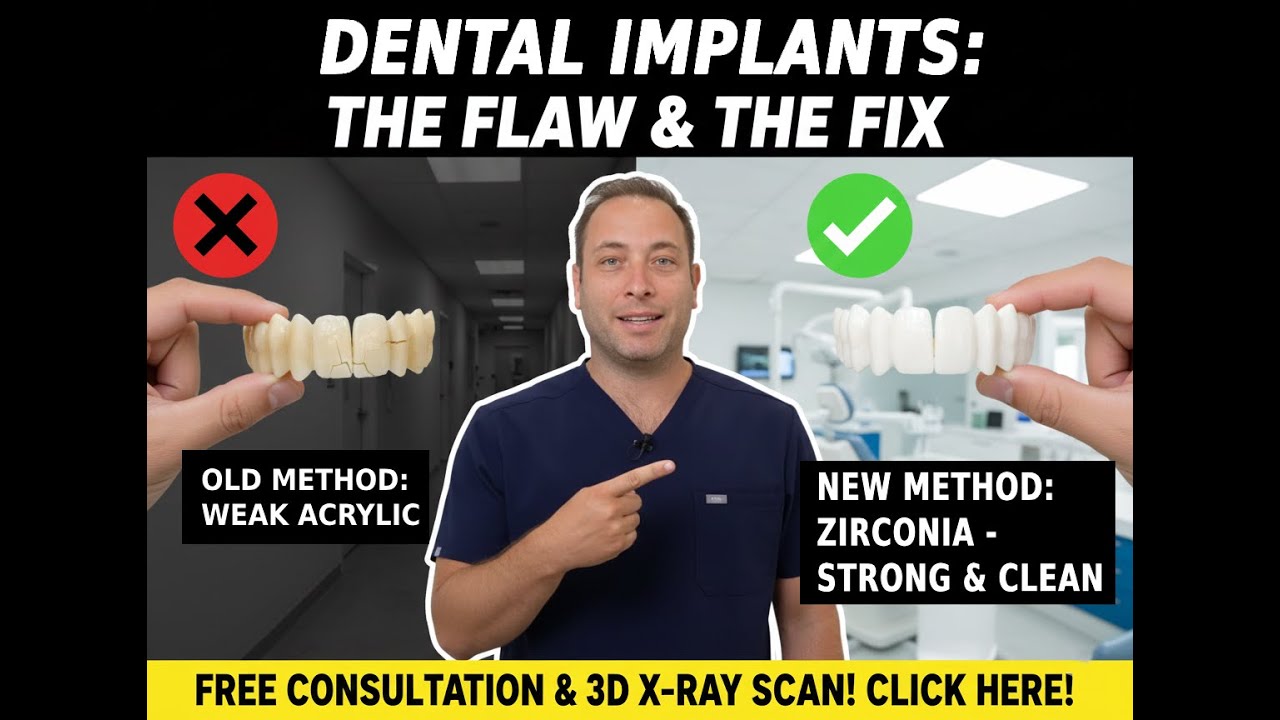
The primary problem was the recommended prosthetic material: acrylic. At the time Dr. Malo developed his technique, acrylic was the only readily available material with the properties needed for immediate fixed restorations. We knew it well from denture fabrication, and it seemed like a reasonable choice.
However, acrylic presents significant challenges for fixed prosthetics. It is porous, allowing bacteria to accumulate on and within the material. With fixed restorations, bite forces are much higher than with removable dentures, leading to wear, chipping, and teeth popping off the base. Patients often required replacement of teeth every three to five years, creating ongoing inconvenience and expense.
Another issue was anatomical limitations. The standard All-on-4 placed four implants where bone was available, typically toward the front of the jaw. For patients with large sinuses and minimal posterior bone, this meant chewing primarily with the front of their mouth. We had patients return saying, "I want more teeth. I want to chew properly in the back." But the original All-on-4 design did not offer a solution for posterior chewing function.
Finally, the original procedure required significant bone reduction to accommodate the acrylic prosthetic's thickness requirements. This aggressive reduction removed healthy bone that could have been preserved with thinner, stronger materials.
The Modern Evolution: Better Materials, Better Outcomes
Over the past two decades, implant dentistry has continued to evolve. We have learned from the limitations of earlier approaches and developed solutions that address them directly.
The most significant change has been the transition to zirconia prosthetics. This advanced ceramic material is stronger than acrylic, allowing thinner, more comfortable designs that preserve bone. It is non-porous, so bacteria cannot penetrate the surface. It looks better, feels better, and lasts longer. The problems of chipping, wear, and frequent repairs largely disappear.
We have also refined our understanding of implant number and positioning. While four implants can work for many patients, some benefit from five or six implants for enhanced stability and posterior function. Modern imaging and planning technology allow us to evaluate each patient's unique anatomy and design an optimal solution rather than applying a one-size-fits-all protocol.
For patients with challenging anatomy, techniques like the 3-on-6 approach provide alternatives that deliver full arch function without the limitations of traditional designs. These newer options bridge the gap between the original All-on-4 and more complex traditional bridge approaches.
What This Means for Calgary Patients Today
If you are considering full arch dental implants in 2025, you benefit from decades of innovation and learning. The primitive single-tooth approaches are history. The complex, expensive bridge protocols with mandatory sinus lifts are largely obsolete. Even the original All-on-4 has been superseded by refined techniques using superior materials.
Today's best practices combine the accessibility and efficiency of All-on-4 with the durability of zirconia and the customization made possible by advanced digital planning. We can offer teeth in a day to most patients without accepting the compromises of earlier techniques.
At SmileNow Dental Implants, we have evolved alongside the field. We use modern zirconia prosthetics, refined surgical protocols, and individualized treatment planning to deliver results that exceed what was possible even a decade ago. We have seen the full arc of this technology's development, from the early days to today's state of the art, and we apply those lessons to every case we treat.
The story of dental implants is still being written. New materials, techniques, and technologies continue to emerge. But one thing is clear: patients today have access to solutions that are safer, more predictable, more comfortable, and more durable than ever before in history.
If you are researching your options for full arch restoration, make sure you are getting modern solutions, not outdated techniques. Ask about prosthetic materials. Ask how many implants will be placed and why. Ask whether your specific anatomy has been considered in the treatment plan.
Ready to learn what modern implant dentistry can do for you? Schedule your complimentary consultation at our Calgary clinic. We will assess your situation using the latest diagnostic technology, explain your options in detail, and design a treatment plan that takes advantage of everything modern implantology has to offer. You can also read our guide on complete dental implant options in Calgary to prepare for your visit.